Whole-house water filtration for rural tank, bore & dam water.
Licensed plumber supplying and installing whole-house filtration for tank, bore and dam water. Servicing farms and rural properties around Albury & Wodonga — Yackandandah, Beechworth, Tallangatta, Howlong, Gerogery, Wangaratta and everywhere between.
Get a filtration quote — call or send photos

Fill out the contact form and I'll get back to you soon!
Fastest: call Marcus and discuss your water tank — most liner quotes start with a phone call and a few photos of your tank.
No obligation, no call-out fee for a quote.
Prefer email? Please include the tank capacity (litres or dimensions - height x diameter) and town — you'll get a reply from concretewatertankrepairs@gmail.com.
Photos help a lot — text them to 0449 933 085 or email them to concretewatertankrepairs@gmail.com.
Best shots: the whole tank (helps me judge capacity), any visible damage, and the outlet so I can size the pipework.
Tank cleaning & filtration: what's in your tank water
If you're on town water, someone else is doing the treatment. On a rural block, you're the water authority. Nobody tests your supply, nobody chlorinates it, and nobody tells you when something's gone wrong.
What ends up in a rainwater tank between roof and tap: bird and possum droppings off the roof, leaf litter and tannins from overhanging gums, dust and grit from an unsealed road, dead insects, frogs and the occasional bird through a failed inlet screen, and anaerobic bacteria breaking the whole lot down into black sludge on the floor.
Most of the time it's fine. Tank water has been drunk in this country for two hundred years. The problem is you have no way of knowing which times are the exceptions — and the exceptions are the ones that put someone in bed for three days.
The usual signs something's off: water goes cloudy after heavy rain · a musty or earthy taste · a rotten-egg smell · tea-coloured water after autumn leaf drop · grit in the aerators and shower heads.
Why tank, bore & dam water needs UV
Sediment and carbon filters do a lot: they take out the grit, the tannins, the tastes and the smells. What they don't do is kill anything.
A carbon filter makes contaminated water taste fine. That's the part people miss — you can filter your way to clear, sweet water that still carries E. coli, giardia or other harmful bugs.
UV is what closes that gap. Water passes a UV lamp on the way to the house and the light destroys the DNA of bacteria, viruses and protozoa so they can't reproduce. No chemicals, nothing added, no taste change. 99.99% of pathogens.
If you're on town supply, you don't need it. If your drinking water comes off a roof, out of a bore or out of a dam, it's the single most worthwhile thing you can add.
What filtration fixes — and the signs to look for
Filtration isn't one product — it's matching the right protection to your water. Here's what it fixes, and the tell-tale signs to look for out this way:
Sediment & grit
Quick check: lift the lid on your toilet cistern. If there's grit and silt settled in the bottom, that same sediment is running through your whole house — blocking tap aerators, gunking up pipework and appliances.
A filter is the barrier that stops it. (And if the source is tank sludge, a tank clean clears it at the bottom of the tank.)
Taste, odour & discolouration
Earthy or musty water, off taste, or a tea-coloured tinge all point to organic matter in the tank — and anaerobic bacteria living inside that sediment layer. In extreme cases you'll see a stain ring around the edge of the bathtub.
A carbon filter is the buffer between that tank and your tap: sweet, crisp rainwater at the kitchen sink while your tank does its job.
Drinking water confidence
For families on tank water, UV treatment neutralises bacteria without adding a thing to your water — no chemicals, no taste. It lets you keep your tank low-maintenance while the filter protects the household.

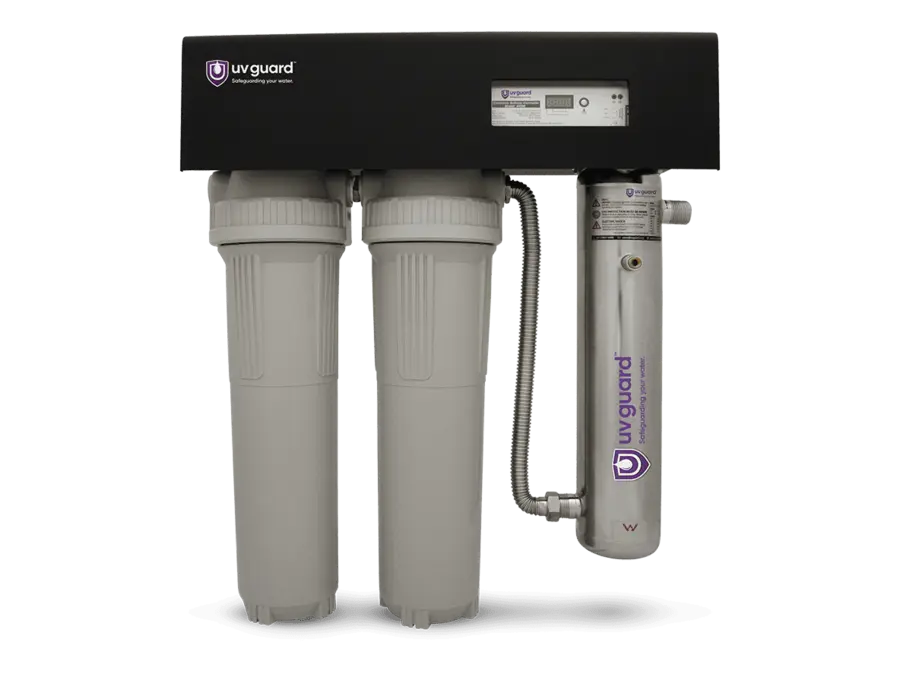
Our top pick: the UV Guard CWP-Series
We can install a range of filters — but the UV Guard CWP-Series below is our top pick for rural living and tank water.
- Australian-made whole-house water filter — 12-month filter changes for a family of 3–4.
- Weather-resistant — lives out near the pump in the Australian weather, or in the pump-shed.
- Protects your home's plumbing from sediment — taps, valves, aerators and the like.
- Uses universal, standard 20″ filter cartridges — order from UV Guard, or widely available online and in retail plumbing stores.
- UV Guard offer excellent after-sales service and support.

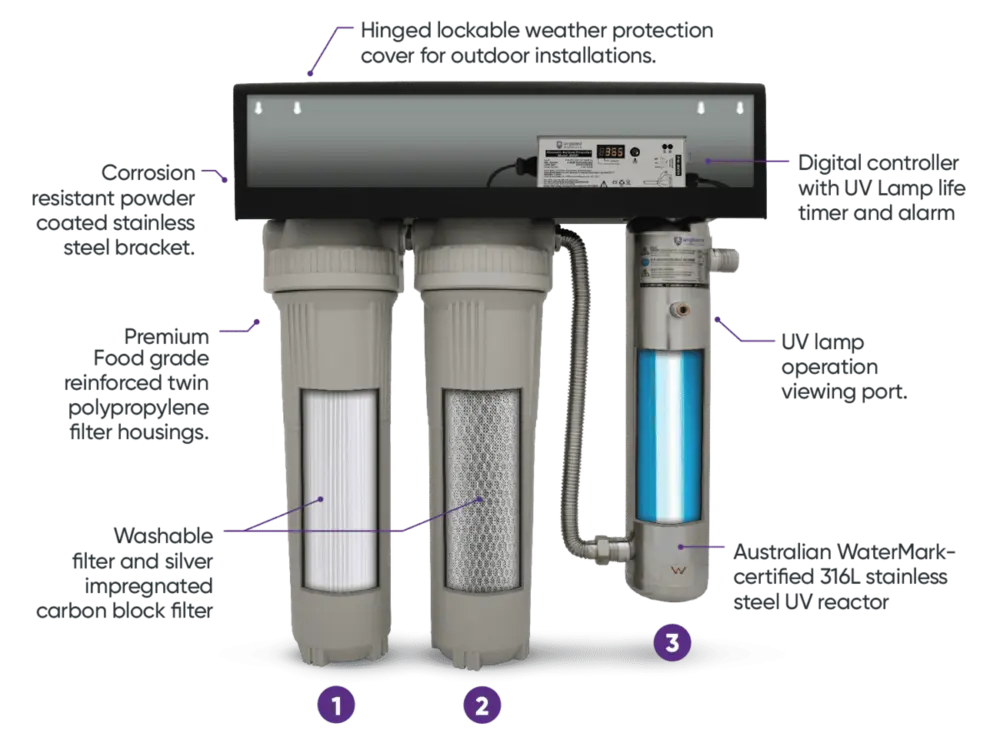
1 · Sediment filter
A 20-micron pleated, washable filter catches silt, dirt and rust before it reaches your taps.
2 · Carbon filter
A 5-micron silver-impregnated carbon block improves flavour for sweeter-tasting water, and removes colour and odour.
3 · UV filter
A WaterMark-certified 316 stainless UV steriliser destroys 99.99% of pathogens — E. coli, Giardia and other waterborne bugs — chemical-free.
Easy upkeep
For a household of 3–4 on a well-maintained tank, filter & lamp change about every 12 months — an easy DIY job with clear instructions, ~$400 delivered from UV Guard. Or we can service it for you.
Preparation: Tank cleaning
Before the filter goes on, we can clean the tank during the same visit — so your new filters start on clean water, not sludge.
Got a different problem or a smaller budget? Single-stage setups are quoted after a quick consult about your water.
Filter a clean tank, not a dirty one
Here's something a filter shop won't tell you: putting a filter on a sludged tank is treating the symptom.
If there's 300mm of rotting leaf matter on the floor, your cartridges load up fast, you're changing them more often than you should, and you're paying to filter a problem that could have been vacuumed out.
I do both. Vacuum the tank out, then install the filter on clean water. One visit, one tradesman, and the filter gets a fair go from day one. It's the main advantage of using a plumber who specialises in tanks rather than someone who only sells filters.
What it costs: $2,750 supplied & installed
$2,750 supplied and installed, incl. GST — UV Guard CWP-Series, three-stage, whole house, for properties within 1 hr of Albury. That's the unit, the mounting, the plumbing, the power connection and commissioning. No call-out fee for a quote.
Ongoing: for a household of 3–4 on a well-maintained tank, cartridges roughly every 12 months and the UV lamp annually. Well under the cost of bottled water for a household, and I'll show you how to change them yourself if you'd rather not book a service.
Filtration FAQs
Is rainwater safe to drink without filtration?
Often, yes — plenty of rural households have drunk untreated tank water for decades without trouble. The catch is that you have no way of knowing when it isn't safe. Contamination from a dead animal, a bird strike on the roof or a failed inlet screen doesn't always change the taste. Filtration and UV remove the guesswork.
Do I need UV if I already have sediment and carbon filters?
If your water comes off a roof, a bore or a dam — yes. Sediment and carbon filters remove grit, tannins, tastes and odours, but they don't kill anything. A carbon filter can make contaminated water taste perfectly good. UV is the stage that deals with bacteria, viruses and protozoa.
How often do the cartridges need changing?
Roughly every 12 months for a household of 3–4 on a well-maintained tank, and the UV lamp annually. Heavy sediment loads shorten that. The CWP-Series uses universal 20-inch filters sold everywhere in Australia, so you're not locked into proprietary cartridges.
Will a whole-house filter drop my water pressure?
Correctly sized, no noticeable difference. Pressure loss happens when a unit is undersized for the household or the cartridges are overdue for a change. Sizing it to your house is part of the quote.
Does the UV unit need power? What happens in a blackout?
Yes, it needs a standard power point. In a blackout the lamp is off, so water passing through isn't being treated. For most households that's a short window and not a concern, but it's worth knowing if you're on a property that loses power regularly.
Can you filter bore water?
Yes, though bore water is a different problem to rainwater — iron, hardness and mineral content rather than organic matter. That usually needs a different setup, so bore jobs start with a conversation about what your water is actually doing.
My water's tea-coloured after autumn — will a filter fix it?
A carbon filter will clear the colour and the taste. But tea-coloured water means tannins leaching from leaf matter in the tank, so you're filtering a problem that's still sitting on the tank floor. Cleaning the tank first is the better order.
Do I need to clean my tank before installing a filter?
Not always, but if there's a sludge layer on the floor it's worth doing. Cartridges load up faster on a dirty tank and you'll be changing them more often than you should. I can do both in the one visit.
How long does installation take?
Most whole-house installs are done in a few hours — mounting the unit, plumbing it in, connecting power and commissioning. You'll get a walk-through of how to change the filters yourself before I leave.
Do you service filters you didn't install?
Yes. Servicing, cartridge changes and lamp replacements on most whole-house systems, not just the ones I've supplied.
Tell Marcus what your water's doing.
The taste, the stain around the bath, the grit in the aerators — describe it and you'll get a straight answer on what fixes it, and what's overkill.
Call Marcus — 0449 933 085Service area
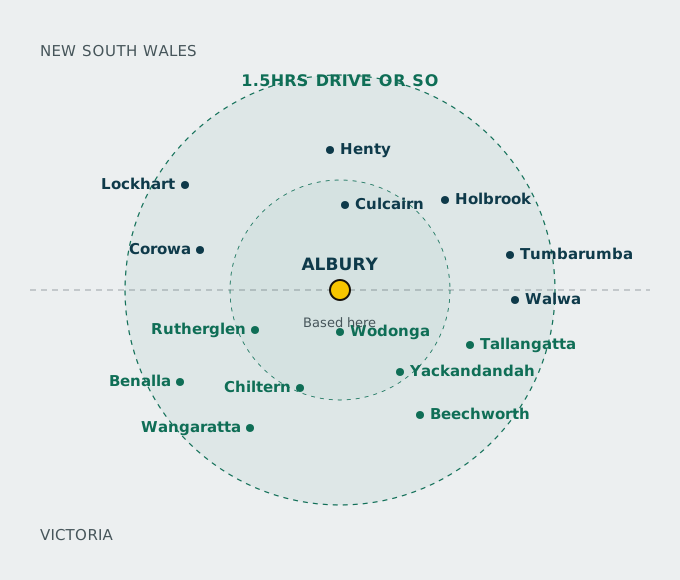
Based in Albury and covering roughly 1.5 hours in every direction — across Southern NSW and North East Victoria.
Yackandandah · Beechworth · Stanley · Tallangatta · Bethanga · Bellbridge · Howlong · Gerogery · Jindera · Burrumbuttock · Walla Walla · Culcairn · Holbrook · Woomargama · Table Top · Wangaratta · Chiltern · Rutherglen · Corowa · Baranduda · Kiewa · Dederang · Myrtleford · Bright · Mount Beauty
Albury and Wodonga too — but most of my filter work is out of town, where there's no mains alternative.
Filtration in the bigger towns nearby: Wagga Wagga · Wangaratta · Shepparton · Deniliquin · Myrtleford · Mansfield · Tumbarumba.